

Simbi coffee
Simbi: Coffee Producer in Rwanda
Rwanda is a vibrant nation defined by its resilience and rich biodiversity. Around three-quarters of its 11 million people live in rural areas, with 90% dependent on agriculture for their livelihoods. An estimated 400,000 Rwandans grow coffee on small farms averaging one hectare, where high altitudes, regular rainfall and volcanic soils create ideal conditions for coffee production.
With less scope for scaled cultivation, Rwandan farmers prioritise the production of specialty Arabica coffee varieties in micro-lots, boosting their competitiveness and attracting premium prices in the international market.
You can read about Simbi Coffee in QR 124, QR 138 and QR 140.
Image: Simbi coffee farmer, Joseline Mukanyandwi,
holds coffee plants on a farm in Rwanda.
Funding facilities for growth: How fair finance is helping Rwandan farmers to trade on their own terms
To achieve a product fit for the growing speciality market, farmers process coffee using a washed method, which involves de-pulping coffee cherries post-harvest, removing the outer husks and fermenting the enclosed beans in water to soften and remove sticky mucilage. The coffee beans are then washed clean, dried and packaged for shipment at coffee washing stations.
In Rwanda, smallholders organise themselves into co-operatives and share services of centralised washing stations. For Simbi Coffee (Simbi), a co-operative based in Huye, southern Rwanda, investments in facilities such as coffee washing stations have been quintessential to expansion, improvement and impact.
Simbi began construction of its first washing station in 2011. The station opened in 2013 – marking Simbi’s first year of trading – with a capacity for processing 300 metric tonnes of coffee cherries per season, servicing over 1,000 smallholder coffee farmers and employing at least 85 people, 80% of whom women.
That same year, Simbi submitted a sample of its high quality, Arabica ‘Red Bourbon’ coffee to ‘The Cup of Excellence’, a prestigious competition and auction for the highest quality coffees on the planet. Simbi’s entry earned ninth place. With thousands of coffees submitted for consideration every year, this remarkable achievement as a newcomer inspired Simbi’s Founder, Abdul Rudahunga, to cement the organisation’s focus on maintaining high quality coffee, whilst increasing production.
A decade later, and Simbi have achieved exactly that, growing from a membership of 300 farmers to 4,500. Since our last feature on Simbi in QR 124, the organisation has established its third coffee washing station and a new dry mill facility and has extended its services to include the provision of fertilisers and pesticides to members and non-members.
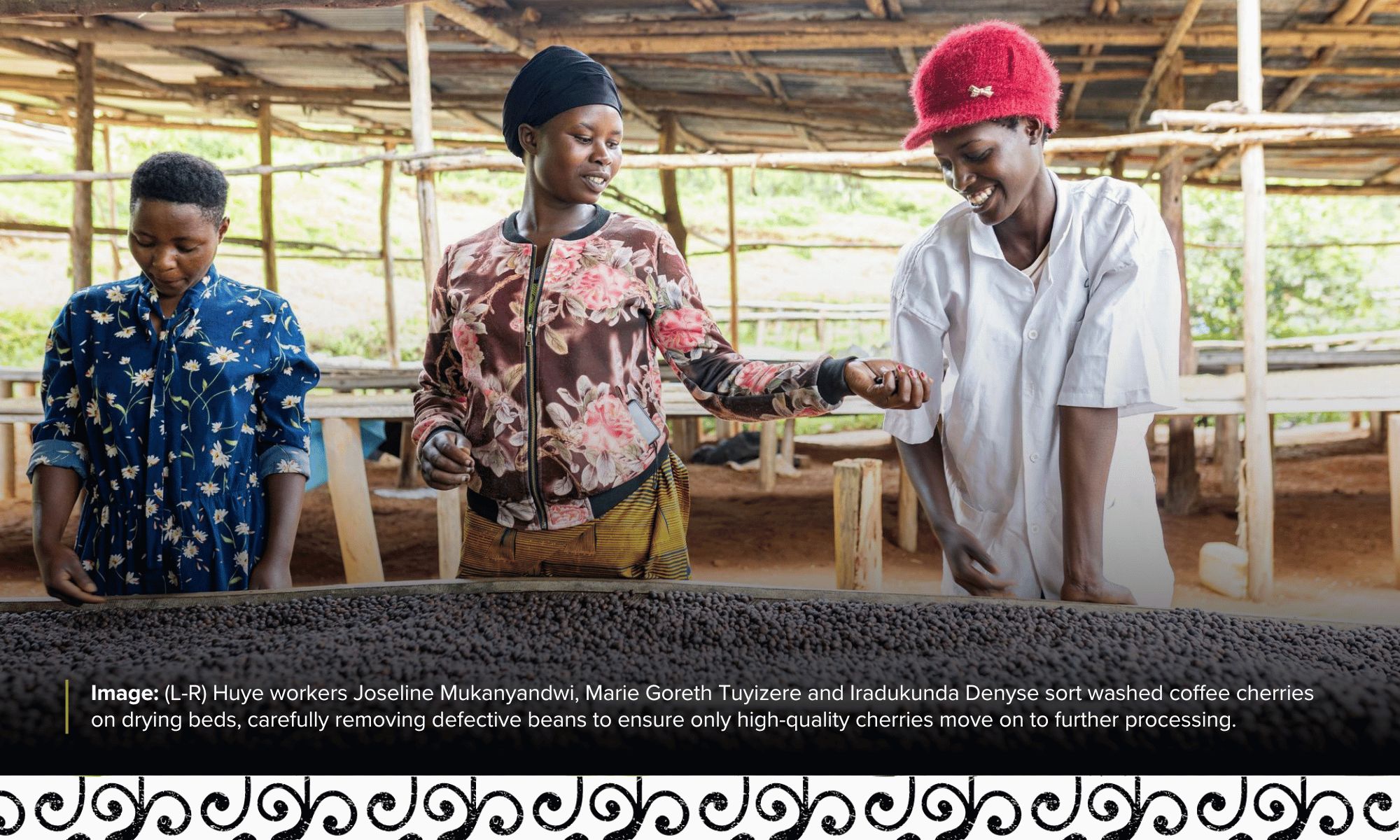
Last summer, Shared Interest Customer Representative, Josephine Mwasaru, visited Simbi and toured its newly constructed warehouse and dry mill.
Josephine said:
“There was a lot of coffee in the store and milling was ongoing. At the time, Simbi was preparing orders for international buyers, and there were women hand-sorting the coffee in preparation for shipment. There was also coffee from other organisations that had sought the milling services from Simbi.”
Investment in a dry mill has meant that Simbi can mill their own coffee, managing standards to remain consistent for buyers, as well as earn additional income milling coffee for other organisations. Simbi has also saved direct costs, including transportation and storage, with the use of their own premises.
Abdul said:
“Operating a dry mill has significantly changed our work, both in terms of efficiency and allowing Simbi to control the entire production chain with complete security and transparency.”
With increased revenue from the dry mill, Abdul says opportunities have been created for members of the local community – many of whom are young women – who can earn an income sorting coffee during the summer season. In addition, the dry mill has allowed continuity of work for employees at its coffee washing stations.
Shared Interest and Simbi Coffee
Shared Interest has supported Simbi since 2021 and remains the co-operative's only social lender. Simbi’s Export Credit facility with Shared Interest has been used to improve its operations and processing capacity, increasing the volume of coffee cherries suppliable to its growing number of clients. Meanwhile, an additional Stock Facility has been utilised to pay farmers for their coffee when they need it most, whilst strengthening the organisation’s cash flow.
Expanding on this point, Abdul said:
“The importance of the Stock Facility is crucial in the coffee cherry purchasing process. Especially when the Stock Facility is paid in advance, it allows us to position ourselves well in advance at coffee cherry collection sites that have the means to purchase, and especially before prices rise significantly.”
Reflecting on the impact of Simbi on local farmers, Josephine said:
“With each order received from buyers, it means a farmer has a ready market for their coffee. I can't think of anything else more fulfilling than to a farmer when they know their labour will not be in vain.”
Coffee farmer Alphonsine Mukarufonsi, said:
“It increased the profit, our life has changed. We have paid for our children to go to school and after school, even life in general goes on well and it is smooth., until now we have no problems.”
Simbi’s commitment to sustainability, social responsibility and fair pay for farmers has developed an inclusive and empowering work environment.
Coffee farmer Nyirabahire Beatta, said:
“With Simbi coffee we are able to get money and solve small problems we may have like paying health insurance and school fees, and other ways one can develop themselves financially.”
Subsequently, these accolades are a fitting tribute to Abdul’s grandmother, one of few rural Rwandans who roasted and enjoyed her own coffee daily, and who inspired the foundation of Simbi.
Whilst Rwanda’s present coffee export volumes account for half that of 1993 – before the harrowing events of civil war and genocide unfolded – current exports represent much greater value, underscoring the success of the government’s renewed focus on quality, rather than quantity.
Together, Simbi and Huye are exemplary materialisations of Rwanda’s culture of innovation and resilience, and are key contributors to the nation’s position as a leading producer of specialty coffee. Shared Interest is proud to support these organisations, with our members’ investments as a vehicle for change, transforming coffee from a humble brew into a symbol of hope.
Invest todayEXPANDING OUR REACH WITH TECHNOLOGY
The beans from Rwanda’s Arabica trees are internationally renowned. Their superior quality increases demand, especially in Europe and the U.S., and also helps increase the price that farmers can get for their coffee berries. Having won a Certificate of Excellence Award in 2013, 2015 and 2018, Simbi Coffee continues to produce a variety of Arabica coffee called Red Bourbon. This is said to have flavour notes of orange and other citrus fruits as well as brown sugar, caramel and chocolate.
Kennedy explained:
“Simbi Coffee negotiates the price with buyers at the beginning of the harvest season and agrees on the final price based on the market before shipment.
“Farmers have faced challenges caused by climate change as Rwanda experiences periods of extreme or little rainfall, which can affect coffee production.”
To help protect the coffee berry quality and yield, the co-operative is encouraging their farmers to become more climate resilient by offering training about soil conservation and good agricultural practices. They also provide their members with organic manure, which they create from coffee husks and other composite materials.
Simbi Coffee, based in Rwanda, became a customer after going through our virtual due diligence process in March 2021.
Shared Interest Head of Lending Paul Sablich said:
Back to map“Virtual due diligence has become a vital part of our work as we aim to reach remote communities without placing our members’ capital at excessive risk.
“However, it is positive that we are able to start some customer visits again, in conjunction with our virtual processes. I do think that an important part of what we do is meeting with farmers and artisans face to face, in order to fully understand their problems and needs.
“This has enabled us to strengthen relations with producer groups, finding better ways to support them, meanwhile expanding into new supply chains in different countries. We have seen businesses grow and Shared Interest has been a fundamental factor in their evolution.
“Visiting farming co-operatives in particular serves as an important reminder of how important our work is - to provide finance so that they can provide a better income for their farmers and - through the Fairtrade Premium - better services to communities.
“Above all else, we want to support businesses, communities and people through times of adversity to reach their full potential. This is why we will continue to explore new regions and products and supply chains, to ensure our finance touches the lives of those who need it most.”