

Huye mountain coffee
Huye Mountain Coffee: Coffee Producer in Rwanda
In Rwanda, almost half a million farmers cultivate coffee at high altitudes on small plots of land, along a cascade of rolling hills. In this pocket of idyllic natural beauty, nutrient-rich volcanic soils, sunshine and ample rainfall provide exceptional conditions for the production of verysome of the highest quality coffee on the planet.
For many years, David Rubanzangabo, Managing Director of Huye Mountain Coffee (Huye), has farmed in the Huye district with his family. Here, beans are hand-picked at peak ripeness, carefully washed and sun-dried on raised beds, ensuring each cup delivers the bright acidity and fruity complexity which embodies Rwandan excellence and heritage.
You can read about Huye in QR 132 and QR 140.
Image: Jeanne Marie Nyiraneza harvests coffee on her farm in Huye, Rwanda. Jeanne Marie cites the support she has received from Huye Mountain Coffee, as instrumental in helping to sustain her family as a single mother over the years.
Make an ethical investmentA history of excellence
In 2012, David established Huye to support neighbouring communities to access global specialty coffee markets. In 2013, the Rubanzangabo family set up a small coffee washing station and began trading. Later that year, Huye earned the coveted ‘Cup of Excellence’ award, which has recognised the world’s most exquisite coffees since 1999.
Over the next five years, Huye invested in a second coffee washing station, specialised staff, larger processing machines, an accounting system and training to control costs and unlock growth.
Shared Interest and Huye Mountain Coffee
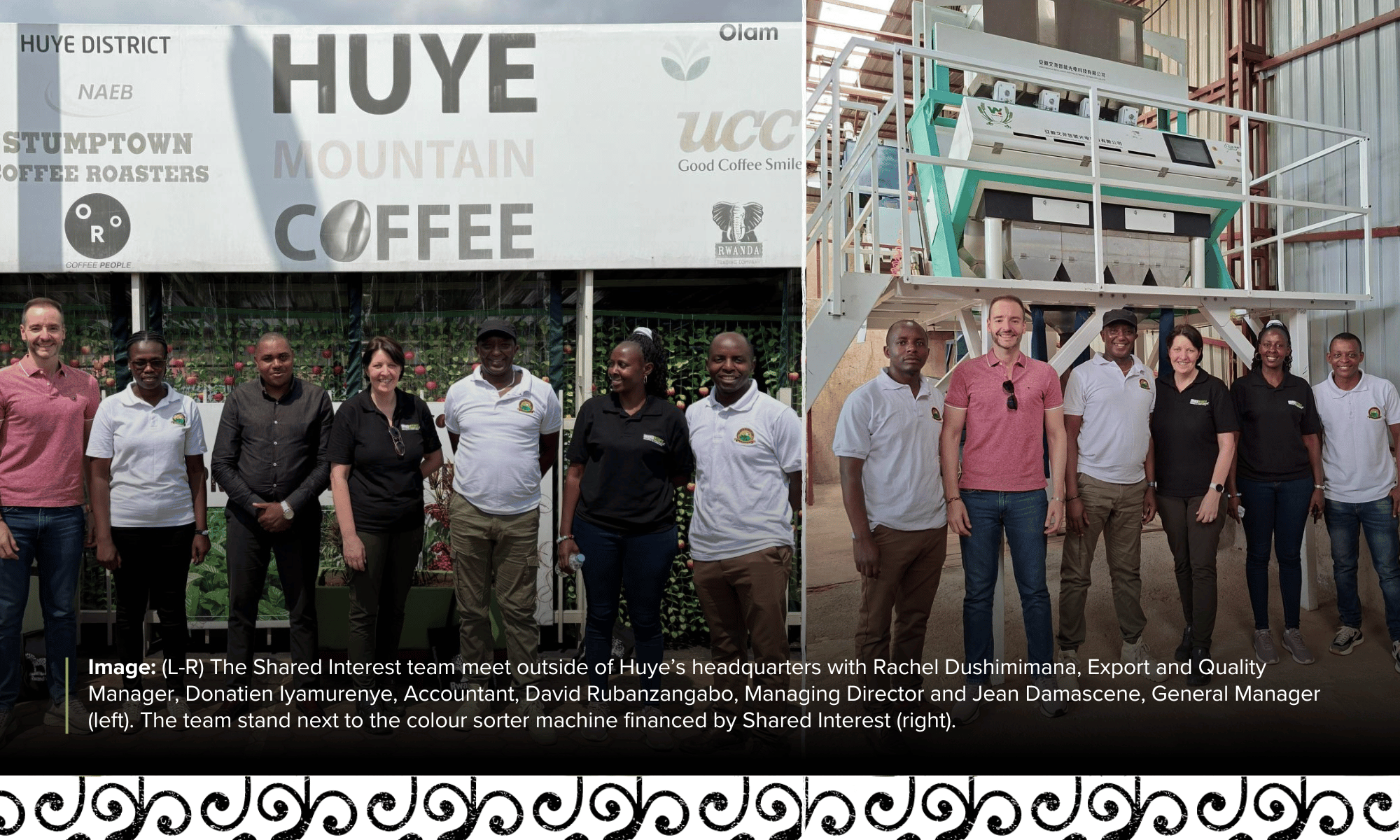
Since 2019, Shared Interest has supported Huye with finance, which has enabled the co-operative to grow sustainably, pay farmers in advance of export and invest in a milling machine, a colour sorter machine and a new warehouse in Kigali.
Earlier this year, Shared Interest Managing Director, Kerrey Baker, visited Huye with Lending Manager, Immaculate Ochieno and Head of Lending, Paul Sablich.
Immaculate shared: “The coffee tour conducted for us was very interesting, starting from the office, to the plantation, to the top of the mountain, where we roasted, ground and drank coffee. From there, we went down to the coffee washing stations and up to the factory, the drying tables and to the lab.”
A future-focused approach
Huye’s steady growth has not been without challenges. Whilst the unique conditions of Rwanda’s tropical highlands produce some of the most renowned coffee beans on the planet, they also factor into soil erosion at high altitudes, flooding in the lowlands and acute temperature changes as a result of climate change, which exacerbate crop vulnerability and instances of pests and diseases.
As a farmer, David understands these challenges, and leads with a proactive, future-focussed approach.
David told us:
“We have a technical team that goes to meet farmers, as well as five trained agronomists. We are introducing intercropping with coffee and bananas … we also organised for farmers to learn how to make manure at home mixed with coffee pulp.”
In addition, Huye conducts coffee tourism, an endeavour which has diversified revenue and marketing opportunities, whilst immersing coffee lovers in the production process.
As a result of Huye’s solution-oriented approach, sales are going from strength-to-strength, with a strong portfolio of buyers in Japan, Singapore, Thailand, the Netherlands and the UK.
On the ground, this translates into increased farm investments, employment opportunities and household income security. Vitally, it creates meaningful opportunities for young people. During the harvest, Huye hire an average of 300 casual workers, 90% of whom are women and young people.
Beyond seasonal employment, Huye delivers generational impact, with the co-operative funding school fees for members’ children and constructing ten water collection points, benefiting around 4,000 people within the Huye and Mbazi districts.
InvestSupporting Producers in responding to climate change
Speaking about the impacts of climate change in the region, David said:
“The region is mountainous so is prone to soil erosion. Food security is an issue due to the vulnerability of certain crops to increased temperatures. Coffee trees are very sensitive to these changes, forcing growers to go to higher lands, which again are more prone to erosion. Meanwhile, the valleys and lowlands suffer from increased flooding, causing loss of human life as well as products and property.
"The southern province has become increasingly dry over the past 20 years. This has caused crop growth to reduce significantly and should this continue, productivity will drop by at least 50%."
Huye Coffee has put measures in place to support its farmers including encouraging farmers to diversify. They have also established a farmer field school to teach Good Agricultural Practice (GAP) techniques such as creating organic compost and planting orange and mango trees for shade.
Speaking about whether the co-operative trained farmers in techniques such as permaculture, David said:
“I produce coffee on my own farm so I understand the challenges faced. We have a technical team that goes to meet farmers, as well as five trained agronomists, and we also receive support from the Rwandan Coffee Board.”
Speaking about how climate change has impacted the needs of producers, Immaculate said: “There is more uncertainty
about production and price, which affects co-operatives being able to pay farmers on time. However, as well as climate change there are also market changes, shipping issues and the impact of Covid-19.”
David added: “We started to see changes three or four years ago, production went down and income was low.
"We are introducing intercropping with coffee and bananas. Intercropping is where we grow two or more crops in proximity to produce a greater yield. It remains difficult to plan ahead - some days there is a lot of rain and others there is a lot of sun. We also organised for farmers to learn how to make manure at home mixed with coffee pulp.”
Invest with us today and create a fairer world for thousands of farmers and artisans across the globe.
Support our work